Litecoin Hash, Bitcoin Ruler: Setting a 0.005 BTC Target
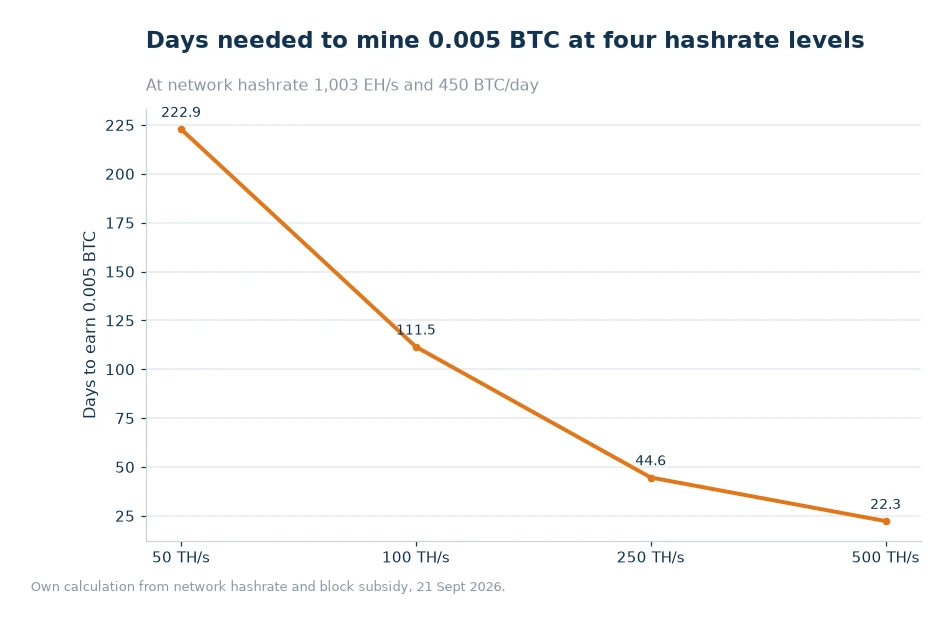
A Litecoin rig still has to be judged in a currency its owner understands, and BTC is the usual yardstick. At 50 TH/s the pool credits roughly 0.000022433 BTC a day, putting a 0.005 BTC target 222.9 days out; at 500 TH/s the same target takes 22.3 days. The gap is pure arithmetic, but the account that produces it does more than one job.

Key takeaways
- 50 TH/s earns 0.000022433 BTC a day, so 0.005 BTC takes 222.9 days at current difficulty.
- 500 TH/s earns 0.00022433 BTC a day and reaches the same target in 22.3 days.
- 0.005 BTC is $423.46 at $84,692, or about 7.14 LTC at $59.32.
- LTC/DOGE merged mining means one submission of work can be credited on two chains.
One submission of work, two chains
Merged mining lets a miner submit proof of work that counts for Litecoin and, at the same time, for Dogecoin. The chains share the work without sharing a ledger, so an LTC rig is not choosing between the two. That is why the pool can list LTC and DOGE under one account and why a miner's daily output often arrives as two balances rather than one.
The practical effect on planning is small but worth stating: the hashrate you point at the LTC pool also participates in the DOGE side, and the payout screen shows the split. A miner who only looks at the LTC line is seeing part of the picture. A miner who converts everything to BTC before comparing months is seeing a consistent one.
Why measure an LTC rig in BTC
Coin prices move at different speeds. Judging a Litecoin operation in Litecoin hides the currency move; judging it in dollars hides the coin move. Measuring the target in BTC keeps one leg fixed and makes the comparison about hashrate and difficulty, which are the variables the operator actually controls. The conversion is simple: 0.005 BTC is $423.46 at $84,692, and at $59.32 per LTC that is about 7.14 LTC.
That second figure is the useful one when the power bill arrives in dollars and the wallet holds LTC. It also sets a reasonable expectation for the shape of the payout: a target worth roughly seven LTC will not arrive as seven equal pieces, because the coin price and the difficulty both move while the run is in progress.
Four hashrate levels, one target
The table keeps the target fixed and moves the hashrate. Daily figures are gross, before the listed fee on the relevant component.
| Hashrate | Daily BTC | Days to 0.005 BTC | Gross USD/day |
|---|---|---|---|
| 50 TH/s | 0.000022433 | 222.9 | $1.90 |
| 100 TH/s | 0.000044865 | 111.5 | $3.80 |
| 250 TH/s | 0.00011216 | 44.6 | $9.50 |
| 500 TH/s | 0.00022433 | 22.3 | $19.00 |
Notice how the $1.90 line behaves. At 50 TH/s, a machine drawing 900 watts at $0.08 per kWh spends $1.73 a day on power, which leaves 17 cents before fees. The target is still reachable in 222.9 days, but the margin is so thin that a ten-cent move in the power rate or a two-week difficulty rise changes the verdict. At 250 TH/s the same power rate is a much smaller fraction of $9.50.
Worked example
Run the numbers from the network down to the target and back up to the coin.
- 450 BTC a day ÷ 1,003,000,000 TH/s = 0.00000044865 BTC per TH/s per day.
- 50 TH/s × 0.00000044865 = 0.000022433 BTC a day.
- 0.005 BTC ÷ 0.000022433 = 222.9 days.
- 222.9 days × 24 = 5,349.6 hours of running.
- At 100 TH/s the daily credit doubles to 0.000044865 BTC and the wait halves to 111.5 days.
- At 250 TH/s: 0.005 ÷ 0.00011216 = 44.6 days.
- At 500 TH/s: 0.005 ÷ 0.00022433 = 22.3 days.
- Value: 0.005 × 84,692 = $423.46, and 423.46 ÷ 59.32 = 7.14 LTC.
Which payout mode fits a smaller rig
PPS+ is the default and settles the block-reward component hourly against current difficulty, with a listed 4% on that component and 2% on the transaction-fee part. The miner does not carry pool luck or orphan risk on the block reward, which is why that rate is higher than the PPLNS one.
PPLNS applies a listed 2% to the combined block reward and fees, waits for six confirmations, and shares the miner's slice across the last five difficulty rounds. For a 50 TH/s rig the difference in listed rate is small in dollars but the timing is not: PPLNS produces lumpier arrivals, and a lumpy arrival on a thin margin is harder to budget against. A rig this size generally values the hourly rhythm more than a fraction of a percent.
What the pool figures add
Two readings on the state page are worth a weekly glance. The total hashrate the pool is working with tells you how often blocks should arrive for the group. The comparison between blocks found and blocks expected over the same window tells you whether the group is running ahead or behind. Neither changes your per-terahash rate, but together they explain why a given week felt quiet.
The ViaBTC LTC Mining Pool view puts those readings next to the coin-level detail, including the split between the two chains that merged mining produces. If the DOGE line is missing from your dashboard, that is a settings question rather than a hashrate one, and it is worth resolving before a long run starts.
Diversification without a second rig
The multi-coin structure of the account is the quiet advantage here. A miner who mines LTC and receives DOGE alongside it holds two assets from one power draw, and the wallet inside the same login can hold both without a separate custody arrangement. Auto Conversion covers the case where one of the two is needed to pay a bill.
None of this changes the days-to-target arithmetic, and it should not be sold as a way to beat it. What it does is spread the price risk that a single-coin miner carries, at the cost of a second balance to track. For a rig earning $1.90 a day gross, that is a reasonable trade; for one earning $19.00, the arithmetic of the target dominates and the currency mix is a smaller consideration.
One caution belongs here. A long run at 50 TH/s spans several difficulty adjustments, and the estimate read on 21 Sept 2026 pointed to a 2.12% reduction in the next one. A softer difficulty helps, but the sequence matters more than any single step: four increases of 3% in a row would push the 222.9-day target past 250 days, while four reductions would pull it nearer 210. Neither outcome is forecastable from today's reading, which is why the target should be held as an order of magnitude rather than a date.
Frequently asked questions
How long does 0.005 BTC take at 500 TH/s?
About 22.3 days at a 1,003 EH/s network, because 500 TH/s earns 0.00022433 BTC a day before fees and the target is five thousandths of a coin.
Does merged mining change the payout rate?
It changes what is credited rather than the per-terahash BTC rate: work submitted once is counted on both chains, so the account shows LTC and DOGE balances while the BTC-equivalent value follows the same hashrate arithmetic.
Is 0.005 BTC a sensible target for a small LTC rig?
It is workable at 250 TH/s and above, where the target arrives in 44.6 days or less; at 50 TH/s the same target takes 222.9 days and leaves little room between gross credit and a power bill.
Fix the target, then choose the hardware
Decide the target in BTC, decide the deadline in days, and let those two numbers set the hashrate. A 0.005 BTC target with a 45-day deadline implies roughly 250 TH/s at current difficulty. Working backwards this way keeps the decision about time and capital rather than about whichever machine happens to be discounted this month.
The Profit Calculator will redo the daily credit at today's difficulty and coin price, and the multi-currency wallet shows how the LTC and DOGE credits accumulate side by side. Recheck both before committing capital, because the numbers in this article are a snapshot from 21 Sept 2026.
Sources: the ViaBTC state, calculator and wallet pages, with chain data read 21 Sept 2026[1]. Network hashrate 1,003 EH/s, difficulty 132.76 T, 3.125 BTC per block, 144 blocks a day, BTC $84,692, LTC $59.32. Published 22 Oct 2026; day counts assume continuous uptime.