Questions Importers Can Ask About Comparing Medical Supply Samples and Specifications
Medical-supply samples should be compared against a controlled specification and destination-market requirements. Product identity, intended use, configuration, test evidence, packaging, and factory must all match the quote. A sample is a review input, not automatic proof that every production unit or regulatory obligation is satisfied.
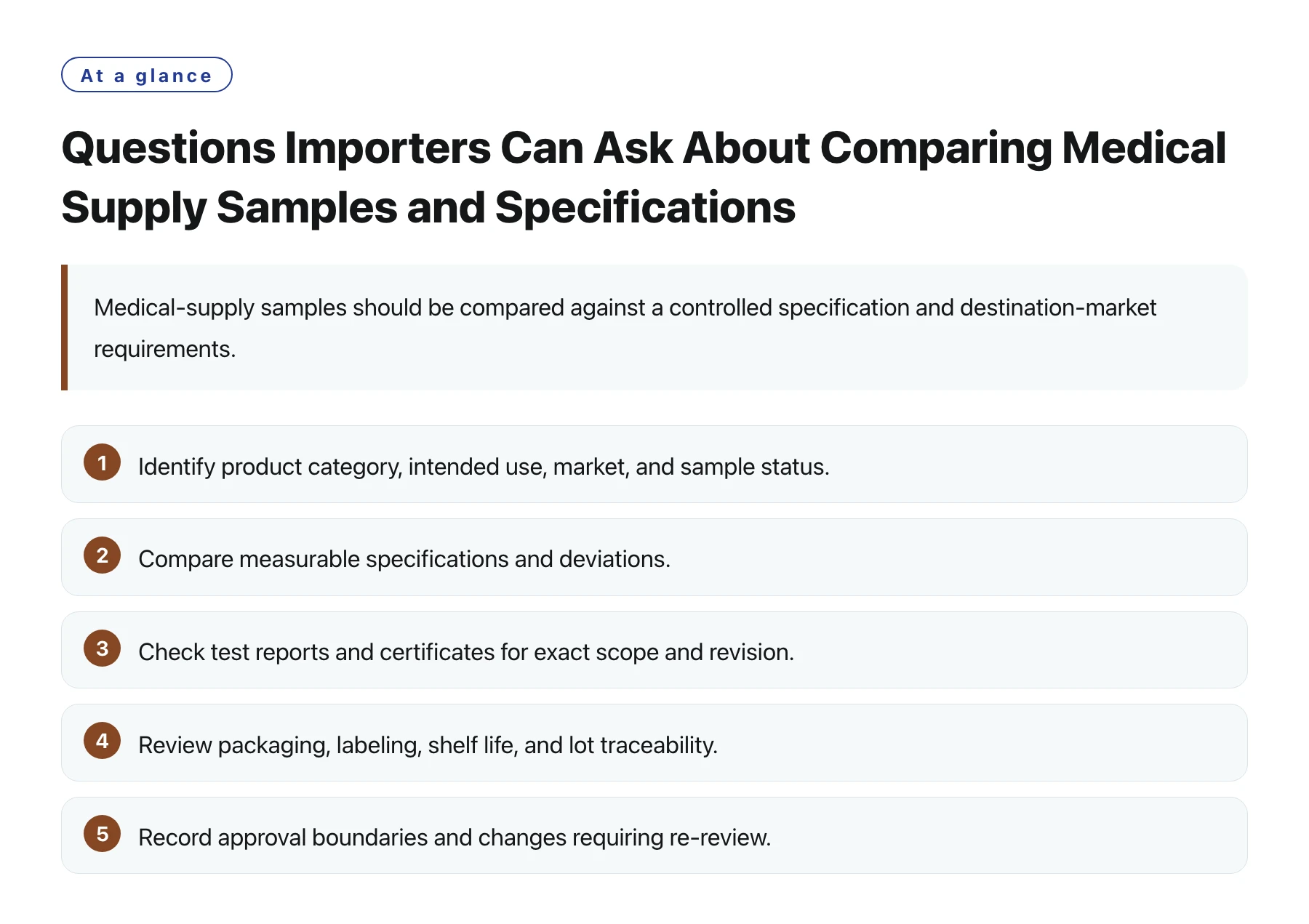
Key takeaways
- Identify product category, intended use, market, and sample status.
- Compare measurable specifications and deviations.
- Check test reports and certificates for exact scope and revision.
- Review packaging, labeling, shelf life, and lot traceability.
- Record approval boundaries and changes requiring re-review.
A sample decision is reliable only when its identity, evidence, and limitations are recorded.
1. What product and intended use does each sample represent?
Ask whether the item is a device, accessory, component, consumable, or another category, and record intended use, user, patient contact, sterility, and destination. The answer may affect documentation and acceptance. Assign classification to a qualified regulatory owner.
Label each sample with supplier, manufacturer, factory, model, revision, lot, date, and sample status. Do not compare an engineering prototype to a production-intent unit without recording the difference.
2. Are the specifications truly comparable?
Compare dimensions, materials, composition, function, performance, tolerance, packaging, label, and accessories line by line. Identify unclear terms such as “medical grade,” “standard,” or “premium” and ask for measurable definitions.
Ask suppliers to disclose omissions and deviations. If a component is optional or substituted, state it separately in the comparison matrix. Similar appearance does not guarantee equivalent function or material.
Ask suppliers to state units, methods, tolerances, and the conditions under which a measurement was taken. Check whether limits refer to individual units, an average, or the production lot. Clarify who decides when results conflict or fall near a specification boundary.
3. How does each sample perform under the intended conditions?
Create a controlled review plan: setup, user action, operating conditions, cycle count, measurement, acceptance limits, and safety precautions. For specialized or patient-contact functions, use qualified reviewers and applicable test methods.
Record observations, measurements, test equipment, sample identity, and open issues. A demonstration can reveal a problem but cannot establish every reliability, safety, or clinical claim. Define what further evidence is needed.
4. Which documents match the sample and product version?
Review test reports, material declarations, quality documents, instructions, labels, risk or performance records where applicable, and traceability. Confirm issuer, date, method, sample, model, factory, revision, and test scope.
For products regulated as medical devices, FDA states that foreign manufacturers exporting to the United States must meet applicable U.S. requirements, including requirements that depend on the product and pathway. Check exact applicability with the importer’s regulatory owner. [1]
5. Does a certificate or listing prove approval?
Ask what a certificate covers: quality system, factory process, material, product testing, or regulatory authorization. FDA registration and device listing do not denote approval of the establishment or product. Verify status through official sources and do not repeat a supplier’s broad approval claim without a legal basis.
Make a separate evidence checklist for each destination market. A document valid for one country or product code may not satisfy another market or configuration. Keep approval decisions with qualified regulatory personnel.
6. Are packaging, labeling, and shelf-life evidence aligned?
Compare primary package, seal, sterile status if relevant, label content, language, lot or serial code, expiry or manufacture date, storage, transport, and accessory configuration. Confirm the sample uses the same packaging materials and process as the quotation.
If package validation or shelf-life testing matters, check that reports identify the precise product and packaging revision. Ask how results are linked to production lots and what triggers reassessment.
7. Can the factory reproduce the approved sample?
Ask where the sample was made, who supplied critical components, and whether production uses the same materials, equipment, process, and inspection. Request a bill of materials, process description, and traceability record where risk warrants.
A sample made by a different site or with hand-selected parts may not represent routine manufacturing. Identify such limits and request production-intent samples or additional controls before award.
Compare the sample’s process history with the proposed manufacturing plan. Record any manual finishing, special inspection, or components that were selected only for evaluation. Require the supplier to confirm which features will be controlled routinely during production.
8. How should options be scored and gaps resolved?
Separate mandatory requirements from preferences. Score functional fit, evidence quality, consistency, packaging, service, delivery, and total cost using the same criteria. Mark missing reports, uncertain claims, and tests not performed as pending.
Assign each gap to an owner with due date and decision consequence. Do not let a low price or attractive sample compensate for an unresolved critical safety or regulatory requirement.
9. What approval and change rules will govern production?
Record accepted sample identifiers, specifications, test evidence, label, package, factory, and revision. State what was approved and what remains conditional. Define who can approve substitutions and whether a new sample or test is required.
Buyers comparing JS Sourcing medical supply sourcing can request a documented supplier and sample workflow, while keeping product acceptance and destination-market decisions with qualified owners.
Sources
Frequently asked questions
Can one sample prove an entire medical supply order is conforming?
No. It represents one identified configuration and condition. Define production controls, lot checks, and documents separately.
What should be checked when comparing samples?
Compare identity, revision, materials, dimensions, function, packaging, labels, evidence, test scope, and production representativeness.
Does a supplier certificate mean a medical product is approved?
Not automatically. Confirm what the certificate covers and verify any required product authorization for the destination.
Who should approve medical-device requirements?
A qualified regulatory and technical owner should determine applicable market obligations and product acceptance criteria.