Private Label Fragrance for Retailers: Building a Range That Sells
A retailer's own-brand fragrance range is a merchandising decision before it is a perfumery one. How many scents, at which price points, in which bottle, replaced how often, and supported by what display: those choices determine whether the range makes money long before the first sample is evaluated. Scent quality matters, but a well-built range with an average scent outsells a beautiful scent in a badly structured range.
Key takeaways
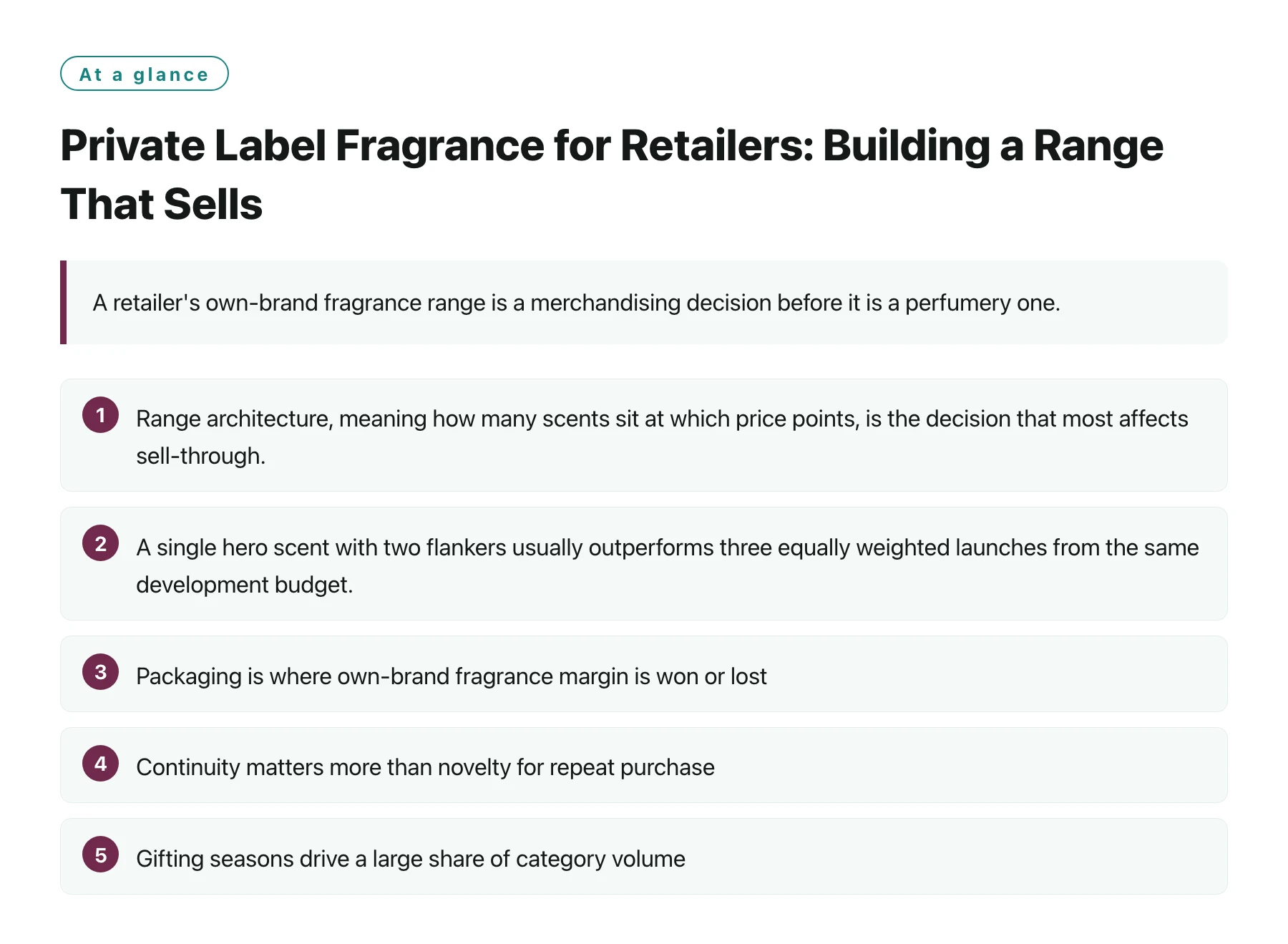
- Range architecture, meaning how many scents sit at which price points, is the decision that most affects sell-through.
- A single hero scent with two flankers usually outperforms three equally weighted launches from the same development budget.
- Packaging is where own-brand fragrance margin is won or lost, because tooling and decoration costs are amortised over the whole range.
- Continuity matters more than novelty for repeat purchase, so the formulation and the supplier's capacity should be secured before launch.
- Gifting seasons drive a large share of category volume, so development timing has to be planned backwards from the retail calendar.
Retailers entering fragrance often start from a scent they like and then build a range around it. The sequence works better the other way: decide the price ladder, the number of facings and the display first, then develop scents that fit those slots.
The reason is mechanical. Own-brand fragrance sells on giftability, price perception and repeat purchase, and each of those is a range property rather than a single product property. A customer who buys the entry price point and enjoys it may return for the mid tier, which is only possible if the range was designed with that journey in mind.
This article covers the decisions a category team can make before development begins, and the supplier questions that follow from them.
Range architecture comes first
Decide the ladder before the scents. A common structure is an entry tier for trial and gifting, a core tier that carries the range identity, and a premium tier for trade-up and personal purchase. Each tier needs its own bottle, its own presentation and its own cost ceiling.
The number of scents in each tier follows from the space you can secure and the display you intend to build, not from how many samples the development team can produce. A range that is too wide for its display sells less per scent and produces more slow-moving stock.
One hero, two flankers, one entry point
A four-scent structure with a clearly supported hero scent gives shoppers a focal point and gives the store something to merchandise. Flankers in the same family extend the shelf presence without a second full development programme, and an entry price point catches gift purchase.
Spreading the same budget evenly across four unrelated scents usually produces four products that nobody promotes, which is the most common structural mistake in a first range.
Flankers work best when they share a recognisable note family, so the range reads as related on shelf. Reference material on aroma materials and their odour descriptions is a practical way to define what belongs in that family before briefing the developer [3].
Decide the replacement rhythm
Own-brand ranges need refresh cycles to keep the display interesting, but changing too often erodes repeat purchase and complicates the supply chain. A fixed rhythm, such as one new introduction per season and one discontinuation, keeps the range moving without invalidating the stock position.
Write that rhythm down before development, because it determines how many scents you will need over a year and therefore how the supplier relationship should be structured.
From category plan to approved product
- Set the price ladder and the cost ceiling per tierWork back from the retail price to the maximum landed cost for the fragrance and the pack at each tier.
- Define the shelf and display footprintDecide the number of facings and the tester arrangement, then let that cap the number of scents.
- Choose the development route per tierA developed concept for the entry tier and a bespoke brief for the hero is a common and efficient split.
- Brief the hero scent properlyGive the developer the market, the customer, the wear profile and the price ceiling, and say what the scent is supposed to communicate.
- Plan packaging across the range, not per scentOne bottle family with different decoration reduces tooling and makes the range recognisable on shelf.
- Test in the environment it will sell inEvaluate the finalists on skin and in the actual store lighting and temperature, with staff and a small panel of shoppers.
- Secure continuity before launchConfirm formulation stability, capacity for the forecast and the replacement rhythm with the supplier in writing.
Margin, markdown and the cost of getting it wrong
Own-brand fragrance margin is unusually sensitive to packaging. The scent is a predictable cost per unit, while the bottle, the cap, the pump, the carton and the display are where tooling, minimum order quantities and decoration decisions accumulate.
That is why range-level packaging planning matters so much. Sharing one bottle family across four scents spreads the tooling across the whole range, while four bespoke bottles multiply it. Consumer spending patterns in beauty and personal care are tracked regularly by market research firms, which is a reasonable way to sanity-check assumptions about price points and gifting behaviour in your market [1].
Where the hidden costs sit
Minimum order quantities on decoration, tester units, display fixtures and label changes after approval are the four items that most often break a range budget. Each should be quoted separately and shown in the plan rather than absorbed into a unit cost.
Ask what the supplier charges for a modification after the formula is approved, because range development rarely ends exactly where it started.
Plan the markdown before the launch
Gifting ranges are seasonal, and a proportion of stock will be sold at a discount or carried into the next season. Deciding how that will be handled in advance protects the margin on the core range and prevents a discount on one tier from resetting price perception across the whole display.
Retail associations and industry bodies publish material on category practice and market structure that can help benchmark these decisions [2].
A four-tier range structure and what to plan for each
| Range tier | Development route | Packaging approach | Main margin risk |
|---|---|---|---|
| Entry point | Adapted existing concept, minimal modification | Small format, stock bottle, simple cap | Low unit margin, so decoration must stay very cheap |
| Hero scent | Bespoke development with exclusivity agreed | Custom bottle family, distinctive closure, clear branding | Development and tooling costs carried by one product |
| Flankers | Modifications of the hero direction in the same family | Same bottle family with different decoration | Cannibalisation if the flankers are too close to the hero |
| Premium tier | Bespoke development with a richer material palette | Heavier glass, secondary packaging, gift presentation | Slow sell-through and a higher markdown exposure |
| Gifting sets | Existing scents combined rather than newly developed | Carton and insert designed for the season | Residual stock once the season closes |
Read the last column as your planning agenda. Each tier carries a different kind of risk, and a range that is well balanced will spread that risk rather than concentrate it in the premium tier where markdowns are most expensive.
The most expensive assumption in own-brand fragrance is that a successful first season makes the second season easy. If the formula belongs to the manufacturer, if the bottle mould is theirs, or if the supplier's capacity is committed elsewhere at your peak, the second season is a commercial negotiation rather than a repeat order. Settle ownership, capacity and continuity in writing before the first purchase order, and ask the manufacturer to confirm what happens if demand runs above forecast. Range architecture is a retail decision, but manufacturers such as Xuelei fragrance brand can advise on what is realistically developable within a single season before you commit the plan.
Sources
- Mintel Press Centre —— Mintel's press releases on consumer and beauty market research, including fragrance and personal care trend reporting.
- Cosmetics Europe —— The European trade association for the cosmetics and personal care industry, publishing guidance, positions and market information.
- The Good Scents Company —— A reference database of aroma materials with odour descriptions, CAS numbers and typical usage information.
Frequently asked questions
How many fragrances should a first own-brand range include?
Four is a workable starting point for a single display: one entry price point, one hero scent, one or two flankers, and a gifting option. The limiting factor should be the shelf space and display you can secure, not the number of samples the developer can produce.
Is private label cheaper than developing a bespoke fragrance?
Usually yes at the development stage, because an existing concept removes the sampling cycle and may reduce the minimum order quantity. It becomes more expensive if the scent is central to the brand, because exclusivity has to be purchased or the concept will be available to comparable retailers.
How far in advance should a gifting range be developed?
Work backwards from the retail calendar and allow for sampling, stability checks, packaging production and shipping before the season's delivery window. Gifting development that starts in the same quarter as the season is usually the reason a launch slips.
What should I ask a manufacturer about replenishment?
Ask how long a repeat order takes, whether the bottle and closure remain available, what the minimum order quantity is for a repeat, and how you would be notified if a material restriction forced a formula change. Those four answers decide whether the range can be sustained.
Do tester units have to be ordered separately?
They are normally a separate line in the quotation, sometimes with a different minimum, and they matter for sell-through because shoppers buy fragrance after trying it. Ask for tester quantities and cost to be shown explicitly rather than assumed to be included.